Notebook 2 - directory conversion, options, and dependencies
This walkthrough mirrors examples/03_convert_directory.py and examples/04_custom_options.py. It converts the complete sample warehouse, inspects dependency rewrites, and compares conservative defaults with opt-in migration options.
from collections import Counter
from pathlib import Path

import matplotlib.pyplot as plt

from sql2sqlx import ConversionOptions, Layout, MergeStrategy, convert_directory, convert_string

ROOT = next(
    path for path in [Path.cwd(), *Path.cwd().parents] if (path / "pyproject.toml").exists()
)
EXAMPLES = ROOT / "examples"
assert (EXAMPLES / "sql").is_dir()
Convert the sample tree
Passing no output directory keeps this notebook side-effect-free: files are returned in memory while preserving the relative paths that would be written under a Dataform definitions/ directory.
result = convert_directory(str(EXAMPLES / "sql"))
summary = [(file.relpath, file.action_type.value, file.action_name) for file in result.files]
summary, len(summary)
([('maintenance/backfill_script.sqlx', 'operations', 'backfill_script'),
  ('maintenance/customer_attrs_merge.sqlx',
   'operations',
   'customer_attrs_merge'),
  ('maintenance/customers_update.sqlx', 'operations', 'customers_update'),
  ('maintenance/orders_delete.sqlx', 'operations', 'orders_delete'),
  ('marts/customer_orders.sqlx', 'view', 'customer_orders'),
  ('marts/order_facts_insert.sqlx', 'operations', 'order_facts_insert'),
  ('sources/events.sqlx', 'operations', 'events'),
  ('staging/customers.sqlx', 'table', 'customers'),
  ('staging/orders.sqlx', 'table', 'orders')],
 9)
Confirm dependency-aware rewrites
The converter scans every statement, records produced targets, and rewrites reads of those targets to ${ref(...)}. It also adds explicit dependencies to operations when order matters.
rewritten = [file for file in result.files if "${ref(" in file.content]
for file in rewritten:
    print(f"===== {file.relpath} =====")
    lines = [
        line for line in file.content.splitlines() if "${ref(" in line or "dependencies:" in line
    ]
    print("\n".join(lines))

assert result.report.refs_rewritten >= 1
assert rewritten
===== maintenance/backfill_script.sqlx =====
FROM ${ref("staging", "orders")}
===== maintenance/customer_attrs_merge.sqlx =====
  dependencies: ["customers_update"]
  SELECT customer_id, last_seen FROM ${ref("staging", "customers")}
===== marts/customer_orders.sqlx =====
  dependencies: ["customers_update", "orders_delete"]
FROM ${ref("staging", "customers")} c
LEFT JOIN ${ref("staging", "orders")} o USING (customer_id)
===== marts/order_facts_insert.sqlx =====
  dependencies: ["backfill_script", "orders_delete"]
FROM ${ref("staging", "orders")}
===== staging/customers.sqlx =====
  dependencies: ["customers_update"]
FROM ${ref("raw", "events")}
===== staging/orders.sqlx =====
  dependencies: ["orders_delete"],
FROM ${ref("raw", "events")}
Visualize the action mix
A directory migration should produce a plausible distribution of Dataform action types. Unexpected spikes in operations often identify scripts that require deeper human review.
counts = Counter(file.action_type.value for file in result.files)
fig, ax = plt.subplots(figsize=(7, 3))
ax.bar(counts.keys(), counts.values(), color="#59A14F")
ax.set_title("Action types emitted from examples/sql")
ax.set_ylabel("files")
ax.set_xlabel("Dataform action type")
ax.tick_params(axis="x", rotation=20)
plt.show()
counts
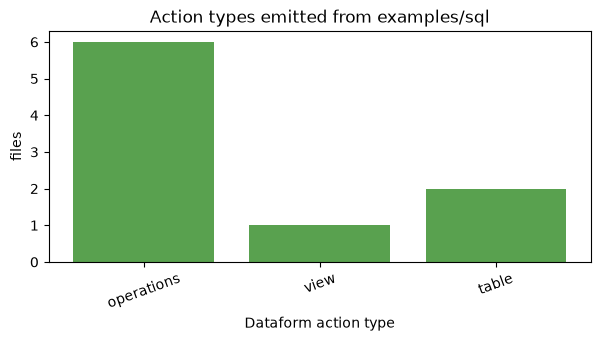
Counter({'operations': 6, 'table': 2, 'view': 1})
Compare non-default options
INCREMENTAL_WHEN_SAFE converts a MERGE only when the converter can identify deterministic upsert semantics. Layout.FLAT is useful when teams want all output files in one folder, and tags adds Dataform tags to every generated action.
options = ConversionOptions(
    merge_strategy=MergeStrategy.INCREMENTAL_WHEN_SAFE,
    layout=Layout.FLAT,
    tags=["migrated", "reviewed"],
    annotate=False,
)
custom = convert_directory(str(EXAMPLES / "sql"), options=options)
custom_summary = [(file.relpath, file.action_type.value, file.action_name) for file in custom.files]
custom_summary
[('backfill_script.sqlx', 'operations', 'backfill_script'),
 ('customer_attrs.sqlx', 'incremental', 'customer_attrs'),
 ('customer_orders.sqlx', 'view', 'customer_orders'),
 ('customers.sqlx', 'table', 'customers'),
 ('customers_update.sqlx', 'operations', 'customers_update'),
 ('events.sqlx', 'operations', 'events'),
 ('order_facts_insert.sqlx', 'operations', 'order_facts_insert'),
 ('orders.sqlx', 'table', 'orders'),
 ('orders_delete.sqlx', 'operations', 'orders_delete')]
Validate option effects
The safe MERGE example becomes an incremental action with uniqueKey, and flat layout removes nested directories from output paths.
customer_attrs = next(file for file in custom.files if file.action_name == "customer_attrs")
print(customer_attrs.content)

assert customer_attrs.action_type.value == "incremental"
assert "uniqueKey:" in customer_attrs.content
assert 'tags: ["migrated", "reviewed"]' in customer_attrs.content
assert all("/" not in file.relpath for file in custom.files)
{
    "default_actions": dict(result.report.actions_by_type),
    "custom_actions": dict(custom.report.actions_by_type),
    "custom_warnings": [warning.code for warning in custom.report.warnings],
}
config {
  type: "incremental",
  schema: "staging",
  name: "customer_attrs",
  protected: true,
  uniqueKey: ["customer_id"],
  dependencies: ["customers_update"],
  tags: ["migrated", "reviewed"]
}

-- Upsert latest customer attributes; provably convertible with
-- --merge-strategy incremental-when-safe.
SELECT customer_id, last_seen FROM ${ref("staging", "customers")}
{'default_actions': {'operations': 6, 'view': 1, 'table': 2},
 'custom_actions': {'operations': 5, 'incremental': 1, 'view': 1, 'table': 2},
 'custom_warnings': ['ORDER_ASSUMED',
  'ORDER_ASSUMED',
  'ORDER_ASSUMED',
  'SCRIPT_FILE',
  'SCRIPT_WRITES',
  'MERGE_INCREMENTAL',
  'TARGET_SCHEMA_REQUIRED',
  'CREATE_NO_AS']}
Synthesize external declarations
When declare_external=True, reads of tables not produced by the migration can become Dataform declarations. This lets the migrated project reference upstream warehouse tables explicitly.
external = convert_string(
    "CREATE TABLE marts.fx AS SELECT * FROM ext_finance.currency_rates;",
    ConversionOptions(declare_external=True),
)
for file in external.files:
    print(f"===== {file.relpath} ({file.action_type.value}) =====")
    print(file.content)

assert any(file.action_type.value == "declaration" for file in external.files)
assert (
    '${ref("ext_finance", "currency_rates")}'
    in next(file for file in external.files if file.action_name == "fx").content
)
===== fx.sqlx (table) =====
config {
  type: "table",
  schema: "marts",
  name: "fx"
}

-- source: input.sql:1 (CREATE TABLE converted by sql2sqlx v0.1.0)
SELECT * FROM ${ref("ext_finance", "currency_rates")}

===== sources/currency_rates.sqlx (declaration) =====
config {
  type: "declaration",
  schema: "ext_finance",
  name: "currency_rates"
}