Notebook 1 - in-memory and single-file conversion
This walkthrough mirrors examples/01_convert_string.py and examples/02_convert_file.py. It validates the core conversion contract: BigQuery DDL metadata moves into Dataform config {} blocks, downstream reads of tables produced in the same migration become ${ref(...)} calls, and DML that cannot be proven safe remains an operations action for review.
from pathlib import Path

import matplotlib.pyplot as plt

from sql2sqlx import convert_file, convert_string

ROOT = next(
    path for path in [Path.cwd(), *Path.cwd().parents] if (path / "pyproject.toml").exists()
)
EXAMPLES = ROOT / "examples"
assert EXAMPLES.is_dir(), EXAMPLES
Convert an in-memory pipeline
The input has two statements. The CTAS is safe to lift into a Dataform table action because its target, query body, partitioning expression, and option metadata are all explicit in the SQL. The INSERT is preserved as operations by the default strategy because append semantics often need human confirmation before becoming an incremental model.
sql = """
CREATE OR REPLACE TABLE analytics.daily_orders
PARTITION BY DATE(order_ts)
OPTIONS(description = "Daily order rollup")
AS
SELECT DATE(order_ts) AS d, COUNT(*) AS n
FROM raw.orders
GROUP BY 1;

INSERT INTO analytics.order_history (d, n)
SELECT d, n FROM analytics.daily_orders;
"""

result = convert_string(sql, name="pipeline.sql")
[(file.relpath, file.action_type.value, file.action_name) for file in result.files]
[('daily_orders.sqlx', 'table', 'daily_orders'),
 ('order_history_insert.sqlx', 'operations', 'order_history_insert')]
Inspect the emitted SQLX
Review the generated files exactly as they would be written to definitions/. The table action contains Dataform metadata and a pure SELECT; the operations action keeps the INSERT statement but rewrites the read of analytics.daily_orders to the generated action name.
for file in result.files:
    print(f"===== {file.relpath} ({file.action_type.value}) =====")
    print(file.content)
    print()
===== daily_orders.sqlx (table) =====
config {
  type: "table",
  schema: "analytics",
  name: "daily_orders",
  description: "Daily order rollup",
  bigquery: {
    partitionBy: "DATE(order_ts)"
  }
}

-- source: pipeline.sql:2 (CREATE TABLE converted by sql2sqlx v0.1.0)
SELECT DATE(order_ts) AS d, COUNT(*) AS n
FROM raw.orders
GROUP BY 1


===== order_history_insert.sqlx (operations) =====
config {
  type: "operations",
  name: "order_history_insert"
}

-- source: pipeline.sql:10 (INSERT converted by sql2sqlx v0.1.0)
INSERT INTO analytics.order_history (d, n)
SELECT d, n FROM ${ref("analytics", "daily_orders")}
Validate conversion invariants
These assertions make the notebook executable documentation. If converter behavior changes, the notebook fails instead of silently publishing stale output.
table = next(file for file in result.files if file.action_name == "daily_orders")
insert = next(file for file in result.files if file.action_name == "order_history_insert")

assert table.action_type.value == "table"
assert 'type: "table"' in table.content
assert 'schema: "analytics"' in table.content
assert 'partitionBy: "DATE(order_ts)"' in table.content
assert 'description: "Daily order rollup"' in table.content
assert insert.action_type.value == "operations"
assert '${ref("analytics", "daily_orders")}' in insert.content
assert result.report.refs_rewritten == 1

{
    "actions": result.report.actions_by_type,
    "refs_rewritten": result.report.refs_rewritten,
    "warnings": [warning.code for warning in result.report.warnings],
}
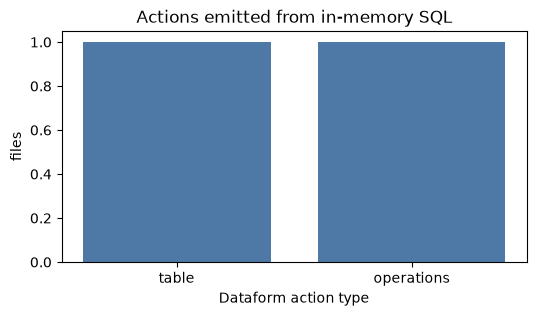
{'actions': {'table': 1, 'operations': 1}, 'refs_rewritten': 1, 'warnings': []}
Convert one repository SQL file
convert_file reads a .sql file from disk and returns the same in-memory result object used by convert_string. The staged-orders example includes partitioning, clustering, labels, and an upstream raw table reference.
single_file = EXAMPLES / "sql" / "staging" / "stg_orders.sql"
file_result = convert_file(str(single_file))
file_sqlx = file_result.files[0]
print(file_sqlx.content)
print("report:", file_result.report.to_dict())
config {
  type: "table",
  schema: "staging",
  name: "orders",
  description: "One row per order event",
  bigquery: {
    partitionBy: "DATE(ts)",
    clusterBy: ["customer_id"],
    labels: {
      layer: "staging",
      owner: "data-eng"
    },
    partitionExpirationDays: 365,
    requirePartitionFilter: true
  }
}

-- source: stg_orders.sql:2 (CREATE TABLE converted by sql2sqlx v0.1.0)
-- Orders staged from the raw event stream.
SELECT
  event_id AS order_id,
  customer_id,
  amount,
  ts
FROM raw.events
WHERE event_type = 'order'

report: {'files_read': 1, 'statements': 1, 'actions_by_type': {'table': 1}, 'refs_rewritten': 0, 'refs_unresolved': ['raw.events'], 'warnings': [], 'failures': {}, 'elapsed_seconds': 0.001, 'input_bytes': 419}
Visualize action counts
Small charts are useful in migration reviews because they show at a glance whether a batch produced the expected mix of tables, views, incrementals, and operations.
counts = result.report.actions_by_type
fig, ax = plt.subplots(figsize=(6, 3))
ax.bar(counts.keys(), counts.values(), color="#4E79A7")
ax.set_title("Actions emitted from in-memory SQL")
ax.set_ylabel("files")
ax.set_xlabel("Dataform action type")
plt.show()